
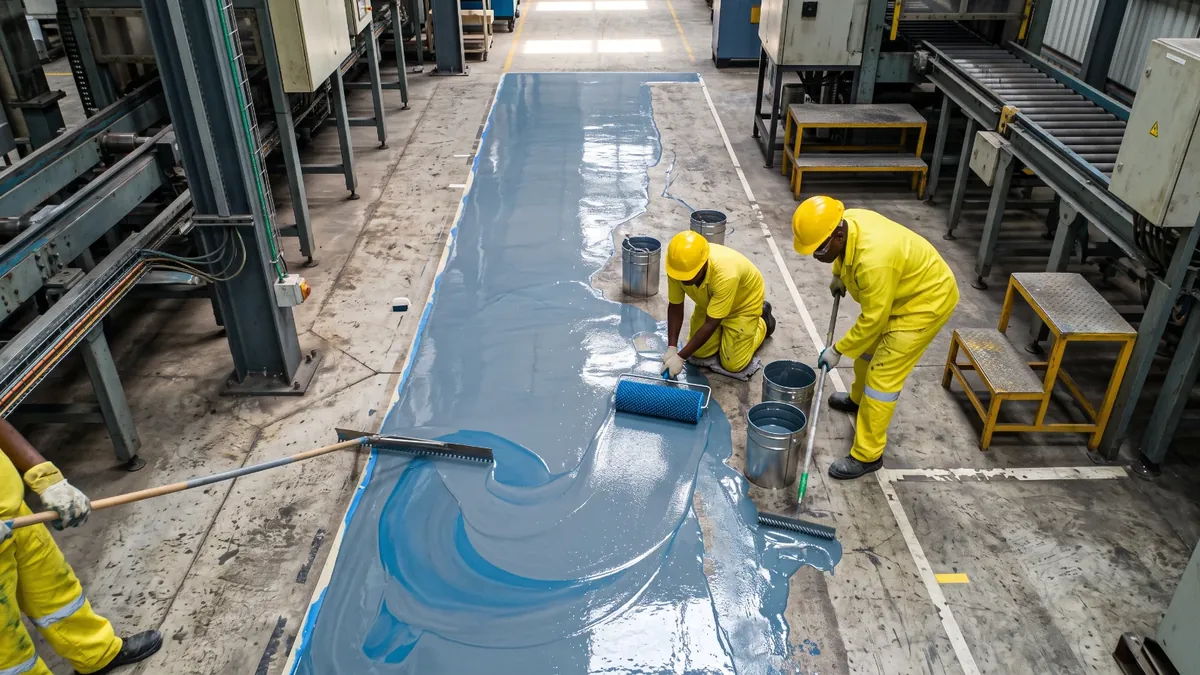
Industrial Epoxy Flooring South Africa helps you find the best quote, fast, on epoxy, polyurethane and concrete floors across South Africa. Say what the building is, roughly how many square metres and what runs over the floor, and flooring contractors who work in your area reply with prices you can line up side by side.
Super easy & fast
- One brief instead of five site visits, so you are not repeating yourself.
- Contractors who work in your area, not a national call centre.
- Ballpark figures below, so you can tell a fair quote from a hopeful one.
- From LEADERR APPROVED providers, vetted and backed by many verified 5-star reviews. Peace of mind that the preparation is in the price rather than added to it later.
- No charge to you, and no obligation to accept any of the quotes.
Describe the floor once and get the best quote, fast.
Get the Best QuoteIndustrial Epoxy Flooring Prices in South Africa
Ballpark ranges across the common systems, so you can check a quotation.
| Item | Ballpark price |
|---|---|
| Diamond grinding the slab back, per square metre | R45 - R120 |
| Shot blasting a large slab, per square metre | R55 - R140 |
| Two coat epoxy floor paint, light duty, per square metre | R180 - R320 |
| High build epoxy, 1 to 2 mm, per square metre | R300 - R600 |
| Self levelling epoxy, 2 to 3 mm, per square metre | R450 - R900 |
| Polyurethane floor coating, per square metre | R280 - R650 |
| Heavy duty polyurethane screed, 6 to 9 mm, per square metre | R900 - R1,900 |
| Self levelling cement screed, per square metre | R180 - R450 |
| Metallic epoxy, per square metre | R700 - R1,500 |
| Flake floor, per square metre | R450 - R1,100 |
| Static dissipative epoxy, per square metre | R550 - R1,200 |
| Polished concrete, per square metre | R250 - R650 |
| Penetrating concrete sealer, per square metre | R60 - R180 |
| Epoxy wall coating, per square metre | R180 - R420 |
| Coving at the wall to floor joint, per linear metre | R180 - R450 |
| Line marking, per linear metre | R35 - R90 |
| Crack and joint repair, per linear metre | R120 - R400 |
| Double garage floor, around 36 square metres | R12,000 - R30,000 |
| Minimum project value most contractors work to | R8,000 - R25,000 |
Prices JUST UPDATED. Ballpark figures, rounded, excluding VAT. They reflect typical South African industrial flooring rates. They are not our prices or quotations, and no provider is bound by them.
What Providers Quote For
| Job | Typical scope |
|---|---|
| Warehouses and factories | Working slabs coated to take forklifts, pallets and wheel loads. |
| Food and beverage plants | Seamless, coved floors that wash down and drain properly. |
| Workshops and garages | Oil resistant floors for motor, fitting and home workshops. |
| Showrooms and retail | Metallic, flake and polished finishes meant to be looked at. |
| Laboratories and electronics | Static controlled and chemical resistant floors to a spec. |
| Parking decks | Trafficked waterproof coatings for roof decks and basements. |
| Tired concrete slabs | Ground, levelled, repaired and sealed before anything else. |
How a Resin Floor Is Priced
- By the square metre of floor. The figure every other line on the quotation hangs off.
- By the system, not the colour. Thickness and resin type set most of the rate.
- By the state of the slab. Grinding, levelling and repair are the labour, the resin is not.
- By how long you can give up the floor. Night and weekend work prices above a normal week.
- Plus the edges, listed. Coving, drains, thresholds, line marking and steps are separate.
What Changes the Price Most
- How much preparation is in it. The single biggest difference between two quotations.
- Whether the slab is dry. A slab holding moisture needs a barrier primer or it blows.
- How level it has to end up. Flatness costs more than thickness does.
- What runs over the floor. Forklift tyres, steel wheels and hot water are three different specs.
- Access and area. A small room prices well above a hall at the same spec.
What a Quote Should Say
- The rate per square metre. So you can test the total against the area.
- How the slab is prepared. Grinding, shot blasting or scarifying, written down.
- The system and its thickness. Resin type, number of coats and millimetres.
- What the edges cost. Coving, drains and thresholds are often a separate line.
- What is excluded. Moisture barrier, levelling and crack repair are the usual three.
Get prices for your own setup rather than a range.
Get the Best QuoteWhat to Include in Your Request
- What the building is. Warehouse, factory, kitchen, workshop, lab, garage or deck.
- Where you are. Suburb and town, so you reach contractors who work there.
- The floor area. Square metres, paced out is fine.
- What is on the slab now. Bare concrete, old paint, tiles, screed or a failed coating.
- What runs over it. Forklifts, pallet jacks, hot water, oils, acids or foot traffic.
- Photos. The worst of the floor and the whole bay from a doorway.
Before You Accept a Quote
- Check the preparation line. A quotation that does not name it is probably not pricing it.
- Check the moisture test. A slab on no damp proof membrane needs one before anything.
- Check the thickness. A millimetre either way is most of the difference in price.
- Check the cure times. How many days before foot traffic, and before forklifts.
- Check the payment stages. A deposit, a stage payment and a balance on completion is normal.
What Makes a Resin Floor Fail
- Moisture from below. Vapour pushes through and lifts the coating off in sheets.
- Too little preparation. Resin over laitance or old sealer bonds to the wrong layer.
- The wrong system for the heat. Epoxy softens where a steam hose or hot water is used daily.
- Joints and cracks coated over. They move again and come straight back through the finish.
- Traffic too soon. A floor loaded before it has cured carries that mark for good.
Frequently Asked Questions
How much does industrial epoxy flooring cost in South Africa?
A light duty two coat epoxy is commonly R180 to R320 a square metre, a high build 1 to 2 mm system R300 to R600, and a self levelling 2 to 3 mm floor R450 to R900. Heavy duty polyurethane screed sits well above all of them at R900 to R1,900. Preparation is quoted on top at R45 to R140 a square metre unless the quotation says otherwise.
Why do two quotes for the same floor differ so much?
Usually because of preparation and thickness. Grinding or shot blasting the slab back to a sound surface is real labour, and a cheaper quotation is often the one leaving it out or pricing a thinner system. Ask for the millimetres and the preparation method in writing and the two quotes become comparable.
How long does a floor take, and how long before we can use it?
A few hundred square metres is commonly two to four days on site once preparation is included. After that most systems take about a day before light foot traffic, several days before full traffic and about a week before heavy forklift use or chemical exposure. Cold weather stretches all of it.
Can a resin floor go over an old coating or tiles?
Sometimes, and it is a decision for the contractor on site rather than one to make from a photograph. A sound, well bonded old coating can be ground and overcoated; a flaking one has to come off entirely. Tiles are usually lifted, because what is under them is the floor the new system has to bond to.
Does the slab need to be dry?
Yes, and this is the most common reason a floor fails. A slab cast without a damp proof membrane keeps passing vapour upwards, which lifts a sealed coating off in sheets. The moisture content should be measured before the system is chosen, and where it is high a barrier primer or a moisture tolerant system is used.
Epoxy or polyurethane?
Epoxy is harder, cheaper and the default for a dry warehouse or workshop floor. Polyurethane is more flexible, handles thermal shock and ultraviolet light better and is what a kitchen or a cold store with hot wash downs usually needs. Many buildings end up with both, in different rooms.
Will the floor be slippery?
A smooth gloss resin floor is slippery when wet, which is why aggregate is broadcast into the top coat anywhere water, oil or food is on the floor. Slip resistance is a choice you make with the contractor: more grip is safer and harder to clean, less grip is the opposite.
Can we stay open while the floor is laid?
Often, in sections. Most industrial floors are done bay by bay or over weekends and night shifts so production carries on, and the quotation should say which. Working in sections costs more than giving up the whole floor at once, so it is worth asking for both prices.
Is there a charge for using this site?
No. Send the details once and flooring contractors who work in your area reply with their own prices. You are not committed to any of them and nothing is charged to you for the introduction.
Industrial Flooring Services Across South Africa
Choose what you want quoted
Epoxy Floor Systems
Warehouse Epoxy Flooring
Working slabs coated to take forklift, pallet and rack loads.
Self Levelling Epoxy
Flow applied resin that finds its own level and leaves a seamless floor.
Metallic Epoxy Flooring
Pigment swirled through clear resin for a marbled showroom finish.
Epoxy Flake Flooring
Coloured chip broadcast into the coat, then sealed to a hard wearing finish.
Garage Floor Epoxy
Oil resistant floors for home garages, workshops and fitting bays.
Polyurethane Floors
Polyurethane Flooring
More flexible than epoxy, and better under sunlight and thermal movement.
Polyurethane Screed
Heavy duty PU cement for kitchens, cold stores and wash down areas.
Specialist Floors
Food Grade Flooring
Seamless, coved and drainable floors for food and beverage production.
Anti Static Flooring
Conductive and dissipative floors earthed to protect sensitive work.
Chemical Resistant Floors
Acid and solvent resistant systems for plant rooms, bunds and labs.
Car Park Coatings
Trafficked deck coatings that keep water out of the structure below.
Epoxy Wall Coating
Washable wall coatings, coving and renders to match the floor.
Concrete and Preparation
Polished Concrete
The slab you have, ground, densified and polished rather than covered.
Self Levelling Screed
A cement based topping that takes an uneven slab back to flat.
Concrete Sealer
Penetrating sealers and hardeners that stop a slab dusting.
Concrete Floor Repairs
Cracks, spalled joints and broken edges cut out and rebuilt.
Get the Best Quote, Fast
Client Reviews
Powered by leaderr