
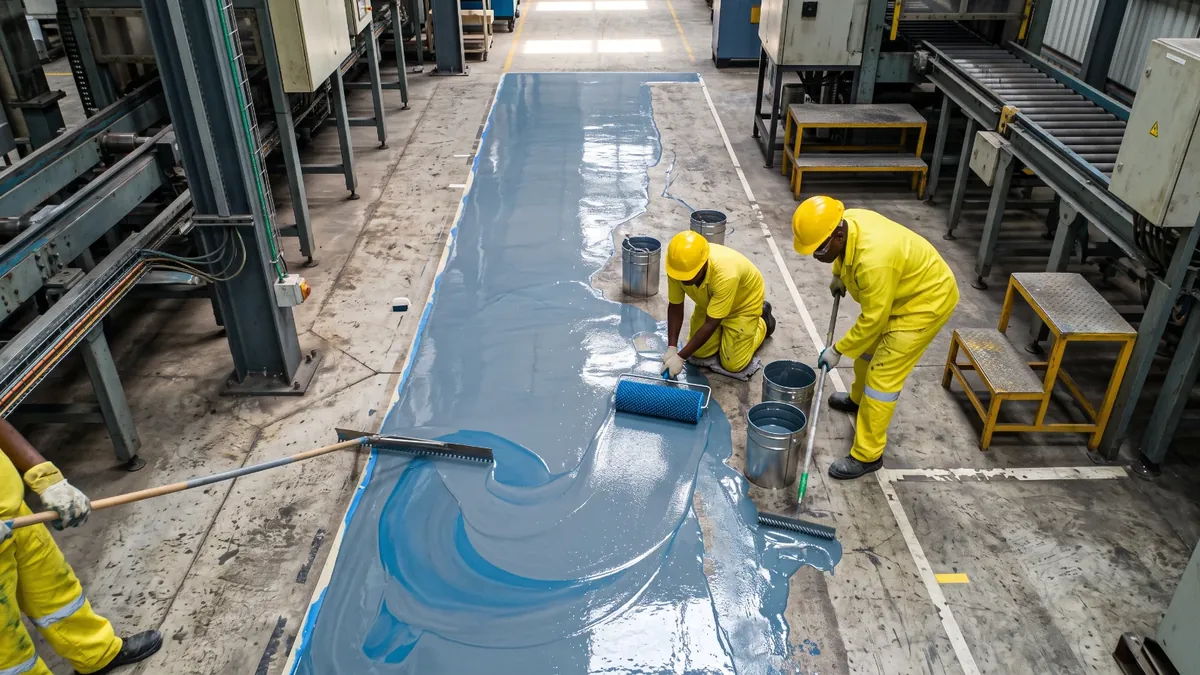
Polyurethane Screed South Africa is the toughest floor in common use and the one specified when a building defeats everything else. Laid 6 to 9 mm thick in a cement based polyurethane mortar, it takes boiling water, steam cleaning, heavy impact and daily chemical wash downs without letting go of the slab. Say what the area is used for, and compare priced quotations.
Super easy & fast
- Know what a heavy duty screed should cost, so you never pay too much.
- Send the same details to several flooring contractors, and quotes come back fast.
- From LEADERR APPROVED providers, vetted and backed by many verified 5-star reviews. Peace of mind that the thickness is specified for the thermal shock.
Say what the area is used for, and get polyurethane screed quotes.
Get the Best QuotePolyurethane Screed Prices
Ballpark figures so you can check a quotation.
| Item | Ballpark price |
|---|---|
| Shot blasting the slab, per square metre | R55 - R140 |
| Polyurethane screed, 4 to 6 mm, per square metre | R750 - R1,400 |
| Polyurethane screed, 6 to 9 mm, per square metre | R900 - R1,900 |
| Coving at the wall joint, per linear metre | R250 - R600 |
| Anchor grooves at edges and drains, per linear metre | R180 - R400 |
| Forming falls to a drain, per square metre | R250 - R700 |
| A 120 square metre kitchen, 6 mm | R130,000 - R260,000 |
| A 400 square metre production hall, 9 mm | R400,000 - R820,000 |
Prices JUST UPDATED. Ballpark figures, rounded, excluding VAT. They reflect typical South African industrial flooring rates. They are not our prices or quotations, and no provider is bound by them. Resin flooring is quoted on the FLOOR AREA and on the PREPARATION the slab needs, so confirm what each quotation includes, such as the grinding or shot blasting, the crack and joint repair, any levelling, the primer, the system thickness in millimetres, and what the coving, drains and line marking cost.
Where It Is Specified
- Commercial kitchens. Hot water, fat and a mop or hose every single day.
- Food and drink production. Wash downs, caustic cleaning and wheeled traffic.
- Cold stores and blast freezers. Where thermal movement pulls thinner floors apart.
- Breweries and bottling halls. Standing water, sugars and heavy pallet traffic.
- Chemical and plating areas. Where spills are part of the normal day.
Why It Survives What Epoxy Does Not
- Thermal shock. It expands at close to the rate concrete does.
- Thickness. Millimetres rather than microns, so impact does not reach the slab.
- Steam and boiling water. Temperatures that soften a thin resin film.
- Moisture tolerance. Some systems go down on a slab that is still green.
- A textured surface. Grip is built into the trowelled finish rather than added.
How the Work Runs on Site
- Survey the falls. Drainage is designed before any screed is mixed.
- Cut in the edges. Anchor grooves at walls, drains and doorways hold it down.
- Prepare the slab. Shot blasted, usually, because the key has to be deep.
- Lay and trowel. Mixed on site and laid in bays to the thickness specified.
- Detail the drains and coving. The part that decides whether it washes down properly.
Get a price for your own building rather than a range.
Get the Best QuoteWhat Affects the Price
- The thickness. Four millimetres against nine is a different floor and a different price.
- The temperatures. Steam and blast freezing push the specification to the top of the range.
- Drainage. Falls, channels and gullies are detailing work, and it is slow.
- Edges and penetrations. Coving, grooves, thresholds and every pipe through the floor.
- The slab. Repair, levelling and the depth of key it will take.
- Working hours. Kitchens and production halls usually mean nights or a shutdown.
What to Include in Your Request
- The address. Suburb and town, so a contractor knows whether they work there.
- The floor area. Square metres, paced out is fine.
- What happens on it. Cooking, washing, freezing, bottling or processing.
- How it is cleaned. Mop, hose, steam or a scrubber, and with what.
- Whether there are drains. How many, and whether the falls work now.
- Photos. The floor, the drains, the wall joints and anything already failing.
Before You Appoint a Flooring Contractor
- Ask for the thickness. It is specified by the thermal load, not chosen by price.
- Ask about the falls. A flat floor in a wash down area is a floor with puddles.
- Ask about anchor grooves. A screed without edge restraint lifts at the perimeter.
- Ask about coving. The wall to floor joint is where a hygiene audit goes wrong.
- Ask about the shutdown. How many days the area is out, and in what sequence.
- Ask what cleaning it will take. Caustic, acid and steam each have a limit.
Polyurethane Screed FAQs
How much does polyurethane screed cost in South Africa?
Commonly R750 to R1,400 a square metre at 4 to 6 mm and R900 to R1,900 at 6 to 9 mm, with shot blasting, coving, anchor grooves and falls quoted separately. A 120 square metre commercial kitchen at 6 mm usually lands between R130,000 and R260,000.
Why is it so much more expensive than epoxy?
Because it is a different thing. Epoxy is a coating a fraction of a millimetre thick; this is a trowelled mortar several millimetres thick, with edge grooves, falls and coving detailed into it. It is specified where a cheaper floor would be replaced every two years, and over that period it is usually the cheaper option.
Can it be laid on a new slab?
Some systems tolerate a green slab far better than epoxy does, which is one reason they get specified on new builds with tight programmes. The contractor still tests the slab, and the answer depends on the system rather than on the family.
Will it stand up to steam cleaning?
That is what it is for. A correctly specified and sufficiently thick screed handles boiling water and steam without debonding, where a thin resin film softens and lifts. The thickness is chosen from the temperature and how often it happens.
How long is the kitchen out of use?
Commonly three to five days for a kitchen sized area once preparation, laying, coving and curing are allowed for, and longer where drains and falls are being rebuilt. Most of this work is done over a shutdown or across nights for that reason.
A heavy duty screed is specified rather than shopped for, and Industrial Epoxy Flooring South Africa is the quickest way to see what the thicknesses cost before you specify one.
Related Services
Get the Best Quote, Fast
Client Reviews
Powered by leaderr