
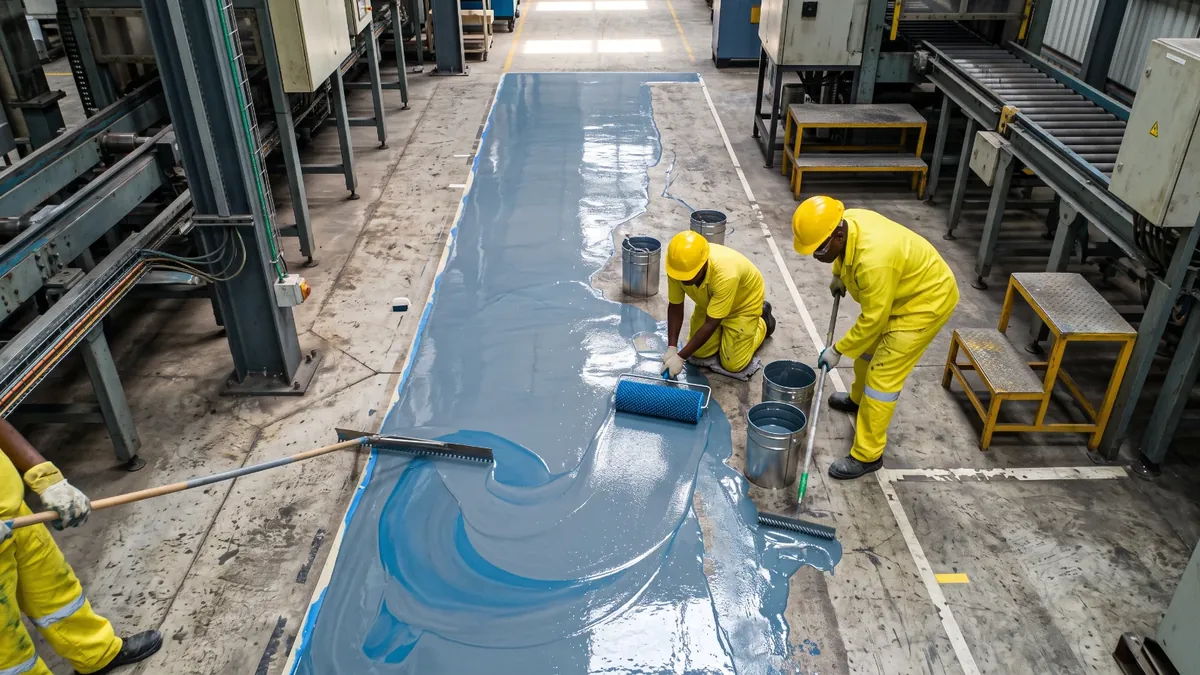
How big is the floor area?
Industrial Epoxy Flooring Coega is sold on the area, the preparation and the millimetres of build, which is why two quotations for one warehouse can differ by half. Send the details once and compare what comes back rather than phoning around for a week.
Super easy & fast
- The best price from a contractor already working near Coega, so travel and plant transport do not get added to the quotation.
- Send your details once, and watch the quotes come in.
- From LEADERR APPROVED providers, vetted and backed by many verified 5-star reviews. Pick a flooring contractor near Coega you can trust.
Send the details once rather than repeating them on the phone.
Get the Best QuoteIndustrial Epoxy Flooring Coega Prices
What a resin floor usually costs, so you have something to check a quote against.
| Item | Ballpark price |
|---|---|
| Diamond grinding the slab back, per square metre | R45 - R120 |
| Shot blasting a large slab, per square metre | R55 - R140 |
| Two coat epoxy floor paint, light duty, per square metre | R180 - R320 |
| High build epoxy, 1 to 2 mm, per square metre | R300 - R600 |
| Self levelling epoxy, 2 to 3 mm, per square metre | R450 - R900 |
| Polyurethane floor coating, per square metre | R280 - R650 |
| Heavy duty polyurethane screed, 6 to 9 mm, per square metre | R900 - R1,900 |
| Self levelling cement screed, per square metre | R180 - R450 |
| Metallic epoxy, per square metre | R700 - R1,500 |
| Flake floor, per square metre | R450 - R1,100 |
| Static dissipative epoxy, per square metre | R550 - R1,200 |
| Polished concrete, per square metre | R250 - R650 |
| Penetrating concrete sealer, per square metre | R60 - R180 |
| Epoxy wall coating, per square metre | R180 - R420 |
| Coving at the wall to floor joint, per linear metre | R180 - R450 |
| Line marking, per linear metre | R35 - R90 |
| Crack and joint repair, per linear metre | R120 - R400 |
| Double garage floor, around 36 square metres | R12,000 - R30,000 |
| Minimum project value most contractors work to | R8,000 - R25,000 |
Prices JUST UPDATED. Ballpark figures, rounded, excluding VAT. They reflect typical South African industrial flooring rates. They are not our prices or quotations, and no provider is bound by them. Resin flooring is quoted on the FLOOR AREA and on the PREPARATION the slab needs, so confirm what each quotation includes, such as the grinding or shot blasting, the crack and joint repair, any levelling, the primer, the system thickness in millimetres, and what the coving, drains and line marking cost.
What Flooring Contractors Near Coega Quote On
- How much floor there is. Rough square metres, or the length and the width if you do not have the area. This is the figure the quotation is built on and the easiest one to leave out of a first message.
- What the slab is doing now. Bare and dusty, sealed, painted, tiled, or carrying a coating that is already lifting. It decides which of the preparation rates on this page applies to your floor, and it is the answer that moves the price most.
- What the building is used for. A warehouse, a workshop, a food or beverage plant, a pharmaceutical or electronics room, a coldroom, a car park deck or a home garage. The use picks the system before anything else does, so saying it up front puts the right contractors on the enquiry.
- What drives and what spills. Forklifts and their tyre type, pallet trucks, steel wheels, hot water wash down, oils, acids or solvents. A floor that fails usually failed on one of these rather than on the resin.
- Whether anything needs repairing or levelling first. Cracks, spalled patches, broken joint edges, a slab that is out of level or one that has a damp patch that never dries. Mention them at the quote stage: they are the commonest reason a final invoice ends up above the quotation.
- The address. The suburb or town near Coega, so a contractor can tell at once whether they work there and what the travel adds. A resin floor brings grinders, a vacuum, mixers and a crew for several days rather than one visit.
- When you want it done, and how cold the slab will be. Resin cures by temperature, so a floor going down in the middle of a highveld or Free State winter wants the slab temperature checked before the mix does, not the forecast. A cold slab slows every system down and a very cold one stops some of them setting properly. Ask what the system needs and whether the building can be warmed, and ask it before the date is fixed.
- Whether the area can be cleared, and for how long. A full shutdown, nights and weekends, or bay by bay with production carrying on alongside. Each is a different price for the same floor, and it is worth saying which is possible rather than leaving it to be discovered on site.
What You Are Paying For on a Resin Floor
- The floor area. Square metres is the figure every rate on this trade is built on, and it is the first thing to get onto a quotation. Measure the whole slab rather than the open part of it: the area under racking, behind machines and inside coldrooms is floor that still has to be coated, and it is the easiest thing to leave off an enquiry.
- The preparation, which is most of the difference between two prices. Diamond grinding or shot blasting back to sound concrete, cutting out what is loose, filling and priming. The table on this page carries a grinding rate and a shot blasting rate for the same square metre, and the gap between a slab that needs a light grind and one that needs taking back hard is wider than the difference between any two resins. Two quotations for one building usually differ here and nowhere else.
- The state of the slab underneath. A sound, dry, power floated slab takes a coating straight onto it. An old slab with laitance, oil in it, a failed coating on top or moisture coming up through it has to be dealt with first, and resin put over any of those will lift however good it is. This is the single thing most likely to make a cheap quotation expensive.
- Which system, and how many millimetres of it. A two coat floor paint, a high build epoxy, a self levelling epoxy and a heavy duty polyurethane screed are four different purchases on the same slab, and the table on this page spans them. The build thickness is chosen by the load and the traffic rather than by the budget, so ask what the quotation assumes and why.
- What runs over the floor. Forklift tyres, steel wheeled trolleys, pallet corners, hot wash down water, spilled chemicals or static sensitive assembly all point at different systems. Polyurethane flooring and polyurethane screed are chosen where heat and thermal shock rule epoxy out; chemical resistant floors, food grade flooring and anti static flooring are bought for a requirement rather than for a finish.
- The detail at the edges and the joints. Coving at the wall to floor joint, movement joints picked up and sealed rather than coated over, drains and channels cut in, thresholds and door lines. Coving and joint repair are both linear metre rows in the table on this page because that is how they are quoted, and they are commonly the lines one quotation carries and another does not.
- Repairs the coating cannot cover. Concrete floor repairs where the slab has spalled, cracked or broken away at a joint, and self levelling screed or self levelling epoxy where the surface is out of level. These are priced as work in their own right, before the resin, and a quotation that is silent about a crack you can see is a quotation to question.
- The downtime, and who moves what. A resin floor needs the area empty, clean and at a workable temperature while it cures, and that is production time rather than a detail. Ask how many days the floor is out of use, whether the work can be done in bays or over a shutdown, and who is moving the racking and the stock.
Turn those ballpark figures into a quotation for your own building.
Get the Best QuoteWhat Affects the Price
- The floor area. Square metres is the unit the whole price is built on, and everything else on the quotation is a modifier of it. Small areas also carry the minimum project value that most contractors work to, which is a row in the table on this page.
- The preparation the slab needs. The widest variable on this trade by a long way. The same square metre carries one rate for a light diamond grind and a much higher one when a failed coating, laitance, oil or an uneven surface has to come off first.
- The system, and the millimetres. A light duty floor paint, a high build epoxy, a self levelling epoxy and a heavy duty polyurethane screed are priced in that order, and the gap between the first and the last is several times rather than a few per cent.
- The traffic and what gets spilled. Forklift and steel wheel traffic, hot wash down, thermal shock and chemical exposure each rule some systems out. A system chosen for the wrong traffic is the most expensive saving on this trade.
- The detail work. Coving, joint sealing, drain and channel edges, line marking and anti slip additions are quoted on their own units, by the linear metre or the item, and they are commonly the difference between two quotations for the same slab.
- Repairs found before or during the work. Cracks, spalling, broken joint arrises and a slab out of level are work in their own right. Priced honestly at the quote stage they are a known cost; found afterwards they are a variation.
- The slab temperature, and so the time of year. Resin cures by temperature rather than by the calendar, so a cold slab slows the work and a very cold one can stop a system setting properly. On a highveld or Free State winter that is a real constraint on the programme, and it is the slab that has to be measured rather than the air. Ask what the proposed system needs and what the contractor will do if the building cannot be warmed.
- The travel to Coega, and the plant that comes with it. It does not change the rate for a square metre, but a resin floor arrives with grinders, a vacuum, mixers and a crew for several days, so a contractor already working nearby often comes in lower and can start sooner.
What to Include in Your Request
- Where the building is. The suburb or town near Coega, so a contractor knows whether they work there and what the travel and the plant transport add.
- What the floor is for. A warehouse aisle, a workshop, a production area, a food or beverage plant, a coldroom, a laboratory, a car park deck, a showroom or a home garage. It decides which contractors are the right ones to quote.
- How big the floor area is. The hero question on this page asks it because it is the fact every rate on the quotation is multiplied by, and because it decides whether the job clears the minimum most contractors work to.
- What is on the slab now. Bare concrete, a sealer, old floor paint, a failed resin coating, tiles, vinyl or screed. Photographs of the worst corner are worth more here than any description.
- Whether the slab is dry, and whether it was ever sealed. Moisture coming up through a slab and a sealer left on one are two of the commonest reasons a new floor lifts. Say what you know, and say if you do not know, so the contractor can price a test rather than a guess.
- What drives on it and what gets spilled on it. Forklifts, pallet trucks, steel wheels, hot water, oils, acids or solvents, and whether anything static sensitive is assembled on it.
- Anything already visibly wrong. Cracks, spalled patches, broken joint edges, dips that hold water or a section that has settled. Say so now rather than discovering it once the grinder is on site.
- When you want it done, and how long the area can be closed. A date or a window, whether it can move, and whether the floor can be given up in one go or has to be done in bays. Curing time is a condition of the work rather than a preference.
Before You Accept a Quotation
- Get the area and the millimetres onto the quotation. A quotation with square metres and a build thickness on it can be checked. A lump sum with neither behind it cannot be compared with anything, including the ranges on this page.
- Settle the moisture question before the resin. A slab with water moving up through it will push a coating off, and that is not a resin problem to solve with a better resin. Ask whether the slab will be tested for moisture, what the result would change, and what happens if it comes back high.
- Know where a flooring contractor's work stops. Surface cracks, spalled edges and a slab that is merely uneven are flooring work. A crack that keeps opening, a joint that steps, a slab settling at one end or a floor moving under load are structural questions for an engineer first. Coating over any of them hides it rather than fixing it, and a contractor who never says so is worth a second quote.
- Ask who supplies the system, and what happens if it fails. Whether the material is in the price or charged on top, and what the contractor will do if the floor lifts or wears through. Any warranty comes from a manufacturer and an applicator together rather than from a website, so get the terms from them rather than assuming them.
- Agree the access, the power, the downtime and the clearing up. Who empties the area and moves the racking, where the plant stands, what three phase power there is for the grinders, how many days the floor is out of use, and who takes the concrete dust out of the roof steel afterwards. Cheap to settle beforehand and expensive to argue about after.
- Ask what is excluded. Knowing what is not covered is as useful as knowing what is, particularly coving, line marking, joint work, repairs to what is found under the old floor, and a return visit if the slab turns out to be wetter or worse than it looked.
- Ask what the preparation includes, in writing. This is where almost every price difference on a resin floor lives. Diamond grinding or shot blasting, cutting out what is loose, filling, priming and dealing with a failed coating are each either in the quotation or not, and the cheapest quotation is usually the one that leaves most of them out.
- Check the quotations describe the same floor. The same square metres, the same system, the same build thickness, the same preparation and the same coving and joint work. Otherwise you are not comparing like with like, whatever the totals say.
Industrial Epoxy Flooring Coega FAQs
How much does industrial epoxy flooring cost in Coega?
It follows the floor area, the state of the slab and the system rather than the suburb. The table on this page gives typical South African ranges, commonly R180 to R320 a square metre for a light duty two coat floor paint and R300 to R600 for a high build epoxy, with heavy duty polyurethane screed well above both, and the quotations you get back will price your own floor.
Why do two quotations for the same floor differ so much?
Almost always because of preparation and build thickness. One contractor has priced grinding the slab back, filling and priming and a given number of millimetres of resin, and the other has priced two coats over what is there. Ask both to write down what happens to the slab before the first mix and how thick the finished floor is, and the gap usually explains itself.
Can a floor be coated in winter in Coega?
Resin cures by temperature, so the question is the slab temperature rather than the date. A cold slab slows every system down and a very cold one can stop some of them setting properly, which matters on a highveld or Free State slab in the middle of winter and much less on the coast. Each system has its own minimum, set by its manufacturer, so ask the contractors quoting you what the proposed system needs and whether the building can be warmed.
Do I have to close the whole area while the floor is done?
Not always. Many floors are laid in bays, over a weekend or across a shutdown, and some systems are back in service sooner than others. It changes the price, so say what downtime is possible when you ask for the quote rather than after.
What if the slab is cracked, uneven or damp?
It is dealt with before the resin rather than through it. Concrete floor repairs cut out and fill what has broken, self levelling screed or self levelling epoxy takes out a surface that is out of level, and a damp slab has to be tested and the moisture handled first. A crack that keeps opening or a slab settling at one end is a question for an engineer before any flooring contractor quotes it.
How long does an industrial floor take?
A small workshop is commonly a few days and a large warehouse runs into weeks, and much of it is preparation rather than resin. Curing time is on top of that and depends on the system and on the temperature, so ask what the quotation assumes about how soon forklifts are back on it.
Does the contractor have to be based in Coega?
No, but travel and plant transport are part of most quotations, so a contractor already working in the area often comes in lower and can get to site sooner. A resin floor brings grinders, a vacuum, mixers and a crew for several days rather than a single visit, which is why it shows up in the price.
A resin floor in Coega is one of the jobs providers listed on Industrial Epoxy Flooring South Africa quote for, alongside polyurethane screeds, polished concrete and concrete floor repairs.
Related Services
Nearby Areas
Get the Best Quote, Fast
Client Reviews
Powered by leaderr