
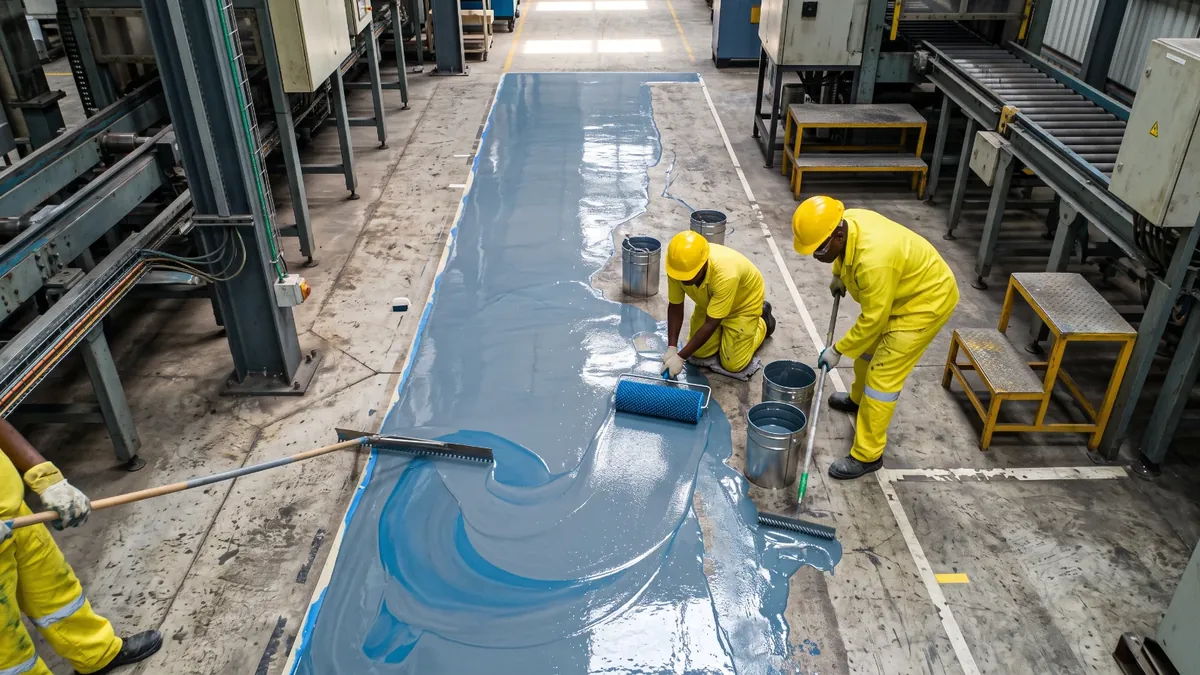
Is the warehouse in use?
Warehouse Epoxy Flooring South Africa is bought for what runs over it rather than for how it looks. Forklift tyres, pallet corners and racking legs all work on the same slab, and the system that survives them is chosen by load and by preparation rather than by colour. Send the area in square metres, what is on the slab now and what drives on it, and compare priced quotations.
Super easy & fast
- Know what a square metre of warehouse floor should cost, so you never pay too much.
- Send the same details to several flooring contractors, and quotes come back fast.
- From LEADERR APPROVED providers, vetted and backed by many verified 5-star reviews. Peace of mind that the preparation is priced rather than skipped.
Send the floor area and the traffic, and get warehouse floor quotes.
Get the Best QuoteWarehouse Epoxy Flooring Prices
Ballpark figures so you can check a quotation.
| Item | Ballpark price |
|---|---|
| Grinding the slab back, per square metre | R45 - R120 |
| Shot blasting a large slab, per square metre | R55 - R140 |
| Two coat epoxy, light duty, per square metre | R180 - R320 |
| High build epoxy, 1 to 2 mm, per square metre | R300 - R600 |
| Self levelling epoxy, 2 to 3 mm, per square metre | R450 - R900 |
| Moisture barrier primer, per square metre | R90 - R220 |
| Line marking, per linear metre | R35 - R90 |
| Coving at the wall joint, per linear metre | R180 - R450 |
| A 1,000 square metre warehouse, high build | R350,000 - R700,000 |
Prices JUST UPDATED. Ballpark figures, rounded, excluding VAT. They reflect typical South African industrial flooring rates. They are not our prices or quotations, and no provider is bound by them. Resin flooring is quoted on the FLOOR AREA and on the PREPARATION the slab needs, so confirm what each quotation includes, such as the grinding or shot blasting, the crack and joint repair, any levelling, the primer, the system thickness in millimetres, and what the coving, drains and line marking cost.
What Decides the System
- The wheel loads. Rubber forklift tyres, steel pallet jacks and reach trucks differ.
- The slab underneath. Its strength sets a ceiling no coating can lift.
- How flat it has to be. Narrow aisle racking is the strictest case there is.
- What gets spilled. Oils, battery acid and hot water each rule systems out.
- How long you can give it up. Bay by bay, weekends only, or the whole floor at once.
Where Quotes Differ Most
- The preparation method. Grinding, shot blasting or scarifying are different days.
- The thickness. A roller coat and a 3 mm screed are not the same floor.
- Repair before resin. Cracks, spalled joints and sunken bays are found once it is ground.
- Moisture in the slab. A barrier primer is a real line item where it is needed.
- Line marking and coving. Aisles, bay numbers, walkways and edges are usually separate.
How the Work Runs on Site
- Clear and measure. Racking moved or worked around, and the area set out in bays.
- Prepare the slab. Mechanical, never acid, so the surface is opened rather than burnt.
- Repair what shows up. Joints cut and filled, holes and spalls rebuilt.
- Prime, then lay. The primer does the bonding and the body coat does the wearing.
- Cure before loading. Foot traffic first, forklifts days later, in that order.
Get a price for your own building rather than a range.
Get the Best QuoteWhat Affects the Price
- The area. Square metres, and a large hall prices below a small store room.
- The state of the slab. Sound and flat, or cracked, oily and sunken.
- The system thickness. Millimetres are most of the difference between two prices.
- The traffic. Pallet jacks, counterbalance forklifts and reach trucks are three specs.
- Working hours. Nights, weekends and shutdowns all carry a premium.
- Edges and markings. Coving, drains, thresholds, aisles and bay numbers.
What to Include in Your Request
- The address. Suburb and town, so a contractor knows whether they work there.
- The floor area. Square metres, paced out is fine.
- What is on the slab now. Bare concrete, old paint, sealer, screed or tiles.
- What drives on it. Forklift type, load weight and how often.
- Whether the building keeps running. It changes the programme and the price.
- Photos. The worst of the floor and the whole bay from a doorway.
Before You Appoint a Flooring Contractor
- Ask how the slab is prepared. The method by name, not the word "prepared".
- Ask for the thickness in millimetres. It is the number that makes two quotes comparable.
- Ask about moisture. Whether the slab was tested, and what the result was.
- Ask how joints are treated. Carried through, filled, or coated over and left to crack.
- Ask about cure times. Days to foot traffic and days to full forklift loading.
- Ask what is excluded. Repairs, levelling and barrier primer are the usual three.
Warehouse Epoxy Flooring FAQs
How much does warehouse epoxy flooring cost in South Africa?
A light duty two coat epoxy is commonly R180 to R320 a square metre, a high build 1 to 2 mm system R300 to R600 and a self levelling floor R450 to R900. Preparation is usually quoted on top at R45 to R140 a square metre, so a 1,000 square metre warehouse in a high build system often lands between R350,000 and R700,000.
Will it take forklift traffic?
A correctly specified one will, and a thin roller applied coating will not for long. Forklift wheels concentrate load into a small contact patch and turn on the spot, which is the movement that tears a thin film. Where counterbalance trucks work all day, a high build or screed system is the sensible starting point.
Can the warehouse stay open while the floor is laid?
Usually, in sections. Most warehouse floors are done bay by bay with racking moved ahead of the work, or over weekends and shutdowns. It costs more than giving up the whole floor at once, so ask for both prices and decide on the difference.
What happens to the joints?
They are cut out, cleaned and filled with a flexible filler, and on a working floor they are usually carried through the finish rather than hidden. A joint coated over moves again and reappears as a crack in the new surface, which is harder to repair than the joint was.
How long before we can load it?
Light foot traffic is commonly about a day, full foot traffic a few days and heavy forklift use about a week, though this varies by system and by temperature. Cold weather slows every resin down, and loading a floor early leaves a mark that does not come out.
A warehouse floor is a long term purchase, and Industrial Epoxy Flooring South Africa is the quickest way to see what the common systems cost before you commit.
Related Services
Get the Best Quote, Fast
Client Reviews
Powered by leaderr